The Complete Guide to Cross-Posting on Social Media in 2026

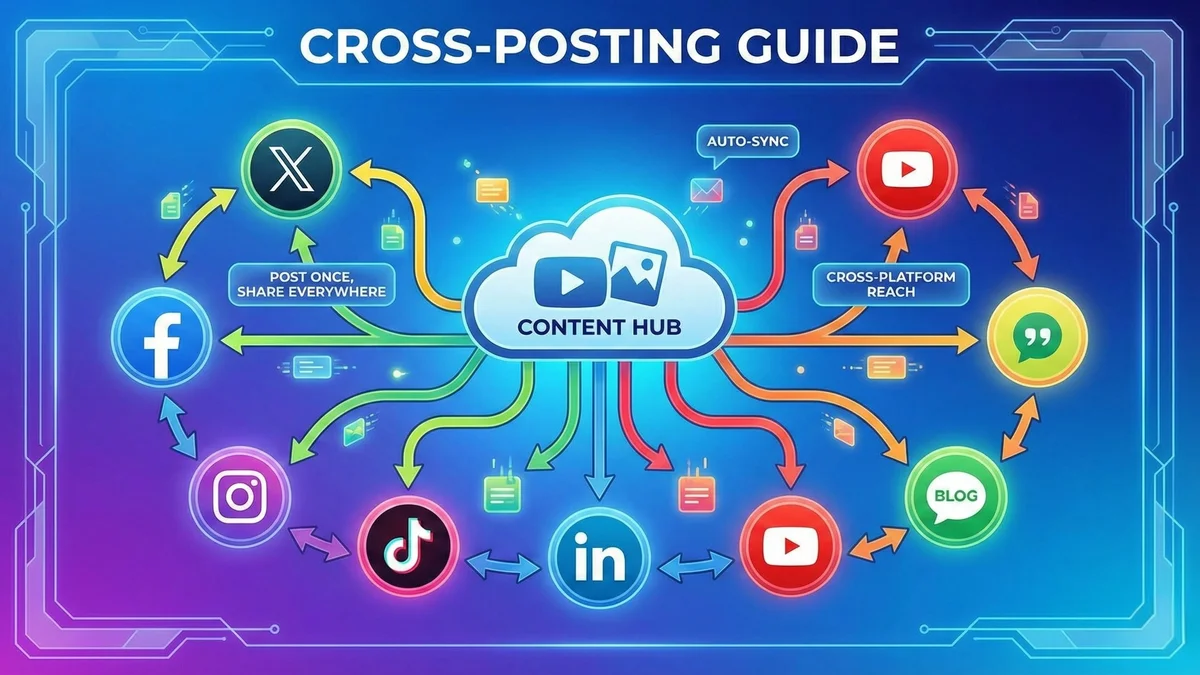
Should you post the same content on every platform? The answer is almost always yes. Cross-posting saves time, maximizes your reach, and ensures your message lands in front of the widest possible audience.
But in 2026, doing it wrong can hurt you more than not doing it at all. The one problem most guides ignore: duplicate content detection.
This guide covers everything you need to know: the benefits, the pitfalls, the platform-specific requirements, and how to avoid getting flagged. For a practical walkthrough, see our companion guide on how to post the same content on multiple platforms.
What Is Cross-Posting?
Cross-posting is the practice of sharing the same piece of content across multiple social media platforms. A video you film for TikTok also goes on Instagram Reels, YouTube Shorts, Facebook, and Snapchat Spotlight. A photo you post on Instagram also appears on Twitter, Facebook, and LinkedIn.
The core idea is simple: create once, distribute everywhere. Instead of producing unique content for each platform from scratch, you leverage one piece of content across your entire social media presence. For a practical walkthrough of how to post the same content on multiple platforms, see our companion guide.
Why Cross-Posting Matters
Time Efficiency
Creating high-quality content is time-consuming. Filming, editing, writing captions, and optimizing for engagement takes hours. Cross-posting lets you get maximum return on that investment by distributing a single piece of content across five or six platforms instead of one. For solo creators and small teams, this is often the difference between being active on multiple platforms or abandoning them.
Wider Audience Reach
Your audience is not all on one platform. Some people spend their time on TikTok, others primarily use Instagram, and a completely different demographic scrolls Facebook. By cross-posting, you reach audience segments that would never discover you if you only posted on a single platform.
Consistent Brand Presence
Maintaining a consistent posting schedule across platforms builds brand recognition and trust. When potential followers or customers see the same content across multiple touchpoints, it reinforces your message and increases the likelihood of conversion.
Algorithm Insurance
Algorithms are unpredictable. A video that flops on TikTok might go viral on Instagram Reels. A post that gets buried on Facebook might perform well on LinkedIn. Cross-posting gives your content multiple chances to find its audience rather than betting everything on one platform's algorithm.
The Challenges of Cross-Posting
Different Format Requirements
Every platform has its own specifications. Instagram feed posts work best at 1080x1350, Stories and Reels need 1080x1920, Twitter images cap at 1600x900, TikTok videos are 1080x1920, YouTube Shorts are 1080x1920, and Facebook feed images perform best at different dimensions still. Blindly uploading the same file everywhere means it will look wrong on at least half your platforms.
Different Caption Cultures
The way people communicate varies dramatically across platforms. Twitter rewards brevity and wit. LinkedIn expects a professional tone. Instagram captions can be longer and more personal. TikTok captions are short but need relevant hashtags. A caption that works perfectly on one platform may feel completely out of place on another.
Posting Time Optimization
Each platform has different peak engagement windows. Posting at 9 AM might be optimal for LinkedIn but terrible for TikTok, where engagement peaks later in the day. Simply posting everywhere at the same time means you are optimizing for one platform at the expense of all others.
The Duplicate Detection Problem
This is the challenge that most cross-posting guides completely ignore, and it is the most critical one in 2026. When you upload the exact same file to multiple platforms, each platform's detection system can identify it as duplicate content. This is true even across different platforms, because some detection databases are shared or because the same content appears in multiple places when users share links.
But the bigger issue is within-platform detection. When the same video is uploaded by ten different accounts on Instagram, all ten copies generate nearly identical fingerprints. Instagram can then identify all but the first as duplicates and suppress them. If you are the fifth person to cross-post a trending TikTok to Reels, your version gets buried.
Best Practices for Cross-Posting in 2026
Adapt the Format for Each Platform
Before uploading, resize and adjust your content for each platform's optimal dimensions. Good content repurposing strategies go beyond simple resizing. A 9:16 vertical video for TikTok should be reframed for a 16:9 horizontal YouTube upload. Instagram feed images should be resized from whatever their original dimensions are to 1080x1350 for maximum screen real estate.
Write Platform-Specific Captions
Take the extra five minutes to write a unique caption for each platform. Use hashtags on Instagram and TikTok, keep it professional on LinkedIn, and be conversational on Twitter. The visual content can be the same, but the text should feel native to each platform.
Stagger Your Posting Times
Do not post to all platforms simultaneously. Stagger your uploads by a few hours or even a day. This serves two purposes: it lets you optimize posting time for each platform's peak hours, and it reduces the chance of cross-platform detection flagging your content as part of a spam or bot operation.
Protect Your Bio Links
When cross-posting across platforms, your bio link is the funnel that converts viewers into customers. But platforms flag suspicious external links just like they flag duplicate content. LinkScale protects your bio links with cloaking and multi-domain rotation, ensuring that no platform blocks or shadowbans your traffic source. Its deep links open in the native browser rather than the in-app browser, bypassing platform tracking entirely.
Make Each Version Technically Unique
This is where most cross-posting strategies fall apart. Even if you resize for different platforms and write different captions, the visual content itself still generates similar or identical fingerprints. The platform does not care about your caption. It cares about the pixels. If the visual content matches something already in its database, it gets flagged.
How MetaGhost Solves Cross-Posting Detection
MetaGhost was built specifically for this problem. Instead of uploading the same file to every platform and hoping for the best, MetaGhost creates a technically unique version of your content for each destination.
Here is what happens when you process a file through MetaGhost:
- Unique metadata per version: Each output file gets its own set of authentic device metadata with unique timestamps, GPS coordinates, and camera signatures. To each platform, it looks like a completely separate photo taken at a different time and place.
- Unique pixel fingerprint: Subtle modifications to the pixel values ensure that each version generates a different perceptual hash. No two outputs will match each other or the original in any hash-based detection system.
- Unique AI signature: Adversarial perturbations ensure that deep learning detection models like SSCD produce completely different feature embeddings for each version. Each copy looks like entirely different content to the AI, while remaining visually identical to the human eye.
- Platform-optimized output: Each version is formatted for the target platform's optimal dimensions and compression, so you get proper sizing without any additional editing step.
The result is that your Instagram version, your TikTok version, your Facebook version, and every other platform version are all technically unique files that cannot be linked to each other by any detection system. You get the time-saving benefit of cross-posting with none of the detection risks.
Cross-Post Smarter, Not Harder
Cross-posting is still the most efficient content strategy for multi-platform growth. But in 2026, uploading the same file everywhere is a recipe for suppressed reach and shadowbanned accounts. The platforms have gotten too good at detecting duplicates.
The solution is not to stop cross-posting. It is to make each version genuinely unique at every detection layer. Get started with MetaGhost and turn one piece of content into unlimited unique versions for every platform.
Ready to protect your content?
Try MetaGhost and make every repost unique and undetectable.
Discover MetaGhostRelated Articles
How Platforms Detect AI-Generated Content in 2026
Platforms flag AI content through C2PA metadata, IPTC tags, and EXIF markers. Learn what triggers the Made with AI label and how to remove it from your photos and videos.
Best Link-in-Bio Tools for Creators: 6 Tested (2026)
Linktree vs Beacons vs Taplink vs LinkScale — compared on conversion, link protection, analytics, and pricing. Find the right tool for your creator business.
Why Your Link-in-Bio Is Not Converting (And How to Fix It)
The hidden reasons your bio link traffic is not turning into revenue: in-app browser issues, link shadowbans, redirect chains, and how to fix each one.